Monday, May 18, 2009

Flashbacks, now and then.

Now

The petite lady to my left had the leathery, wizened skin of someone who had spent the better part of her life bucking the SPF trend. She also had the eyes-half-closed-sway-to-and-fro look of someone who had spent the better part of the evening imbibing something stronger than juice. With the DJ spinning throbbing techno music, she was doing some protracted arm-flopping dance that reminded me of a dignified English woman fluttering through a parlor, checking on her guests having tea.

Under the cover of night, on the terrace of “Villa 33” in Blantyre, Malawi, I looked up and saw a silvery disco ball hanging from a tree.

Having had the impression that this “Braai” (Afrikaans for grill or cook-out) would be a more casual affair, I showed up in flip-flops and a boring T-shirt and was unpleasantly surprised to arrive at a veritable scene, where some of the hippest of Blantyre were decked out for a night of clubbing, some in sky-high heels, skinny jeans, and earrings that scream fabulosity.

So I found myself awkwardly bopping on the dance floor, shifting my gaze from that woman, to the tree, to the maroon-painted concrete floor, everywhere except to my German colleague at my right, and asking myself, how on earth did I get here?

Oh yeah, I remember: Feeling both sore from having hiked Mount Mulanje all day and inadequately dolled up for such an affair, I had a burger and coke and was ready to make a discrete exit. I asked Esme, a cute and bubbly blonde girl who worked at the place for the phone number of a taxi company, and though she was from the British Isles (a guess, based on her accent) and should have understood English, her answer to this question was, oh let me take your purse, stash it in some undisclosed location, pour you an apple pucker shooter, and then drag you onto the dance floor.

And there I was, bouncing on the last of my hamstrings, wishing that that apple pucker shooter had been either a cupful of absinthe (recently legalized in the US after all) or laced with arsenic.

My current 4-week stint in Malawi has brought back a flood of memories from the last two years, mostly memories of Rwanda and other African travels, times and places almost a year since my last post on this blog… Though it started out as another much-loved diary, my blog has lately become nothing but a source of bottomless guilt. It’s not that I haven’t had anything to write about; on the contrary, so much has happened. I have simply lacked the stamina and discipline to write down my thoughts and after a while, it becomes like an old dear friend with whom you’ve totally lost touch: cut off for so long, you scarcely know where to begin and your sense of guilt almost paralyzes you from being able to come across as normal. You wonder if you should just launch into your life as it is, or spend some time recapping everything that’s happened in the intervening months and glossing over the forgotten time in the hopes that he/she doesn’t notice how badly you have neglected him/her.

Then

I thought about the last time I shared a dance floor with colleagues… After a dinner of sushi and white wine, I found myself mangling a rug at Murphy’s, a dance club on the ground floor of the Hilton Hotel, one of two business traveller havens in Ankara, Turkey. My 2009 started with a 2-month project in Ankara, where I proudly watched Obama become the 44th President from my hotel room alone. That sentiment summarizes my time there fairly well, in the sense that my stay in Turkey was overwhelmingly dominated by work and therefore revolved around my hotel room or the client site. In any case, the evening at Murphy’s, a weekend trip to Istanbul, a bomb scare outside the hotel, the start of the Obama years, among others, were all blog-worthy memories that never found their way to paper. A few excuses, some procrastination, and suddenly the opportunity/inspiration to write a Turkey blog post evaporated.

I thought about my last project in Africa – a 5-week sweat-fest in The Gambia. Like Blantyre and Kigali, in no time flat, I found myself tangled in the folds of the expat community of Senegambia, again amazed at how large and small these communities are… Large in the sense that I would have never guessed that Banjul and Senegambia would be home to so many English, Dutch, and Germans; small in the sense that I could not go anywhere without running into at least one familiar face. It was project work of a totally different beast, requiring trips into the deep countryside in the middle of the night and long hours in telecom exchanges staring at masses of tangled cables. I started a love affair with mangoes there that to this day burns unabated (despite not being able to find good ones anywhere since). A trip to James Island, Ramadan by proxy, sabotage and reckless incompetence, and more – all entirely blog-worthy moments, all entirely lost to pure laziness and a dearth of motivation.


There were more moments, including, simply, life in Germany… In 2005 I made my maiden move abroad to Frankfurt and after moving back in August 2008, I felt like it was a homecoming of sorts. Since Frankfurt, I had moved to Brussels and then Kigali and visited countless other places in Europe and Africa, so I arrived back in Germany feeling a bit more like a seasoned traveller. I will never outgrow my inherent naïveté about the world but at least, with all these travels, I have tried to lessen it. Besides happily dusting off my German textbooks, I have enjoyed my job and life in Deutschland. From my perch in Bonn, I have been able to revisit my ole stomping grounds in Brussels, chaperone betrunkenen colleagues at the company Christmas party, take a trip to Edinburgh, wine in a circle during a Carnival extravaganza in Trinidad, celebrate my 30th birthday during a training session in the Netherlands, and go skiing in the German Alps… All, again, fitting stories for my blog but saved from immortalization by a simple inability to get my $%&* together.

Now

I can hardly right past wrongs by writing a bunch of delinquent blog posts now, but I can at least try to resolve to write on my blog with renewed enthusiasm and greater regularity! To that end, this post as well as the subsequent four will be part of a “Flashback” series, meant to recount some of the more memorable interesting encounters here in Malawi, as well as to include snippets of moments past that didn’t make it onto my blog. I hope you enjoy them.


_________________________________________

Malawi Fast Facts

Big City (and the capital): Lilongwe (population ~866,000)
Next Big City (and the financial+commercial center): Blantyre (population ~733,000)
People: ~13,900,000 (more than 10 different ethnic groups, mostly from the Chewa tribe, many Asians and Europeans as well)
Official languages: English, Chichewa
GDP per capita: $312 (nominal)
Size: 118,484 km2 (45,747 mi2, or almost 5 times the size of Rwanda and similar in size to the US state of Pennsylvania)
Elevation of the Shire Highlands (where Blantyre is located): 910 m (3000 ft)
Religion: 80% Christian, 13% Muslim
Primary Exports: Tobacco, sugar, cotton, tea
Life Expectancy: 43
The ravage of AIDS: 14% of population infected, 250 new victims are infected each day, and 70% of Malawi’s hospital beds are occupied by HIV/AIDS patients.
Trivia: Madonna put Malawi on the pop-culture map by adopting a Malawian child, David Banda. She continues to make waves here through her ”Raising Malawi” foundation, which focuses on raising money and building infrastructure to help AIDS orphans, as well as through her bid to adopt a second Malawian child.
Quick History:
1859 David Livingstone reaches Lake Nyasa (today known as Lake Malawi) in Nyasaland, under British colonial rule.
1964 Nyasaland gains independence and renames itself Malawi, under President Banda.
1993-1994 Government reforms enforced, new constitution enacted and first multi-party elections held.

_________________________________________

Thursday, August 14, 2008

Maputo and Tofo Beach, Mozambique.

On June 8, Garron and I boarded a flight from Joburg to Maputo, Mozambique. It was my first visit to this coastal nation and a first to any former Portuguese colony.

_______________________________

Mozambique fast facts


GDP (PPP): $1400
Population: ~21 million
Capital City: Maputo
Official languages: Portuguese
Primary Exports: Cashews, shrimp, fish, cotton, citrus fruits
Religion: ~35% Catholic,~12% Non-Catholic Christian, ~20% Zionist, ~8% Muslim
Independence: 1975
_______________________________


Maputo (~1.2 million) pays homage to Mozambique’s Communist past by naming all of its city streets after prominent Communist/Marxist figures.

For example, we had lunch at the intersection of Avenue Mao Tse Tung and Avenue Kim Il Sung…


What an address!


The beautiful Hotel Polana (didn’t stay there)


Occasionally you can feel the Portuguese influence in the people and food, especially in a particular fondness for a spicy condiment called “peri-peri” sauce. Fiery and quite tasty.


In Maputo, we visited the Museum of Natural History and I was terrified by the vast collection of creepy taxidermy there: taxidermy on the order of an entire floor filled with dusty relics of wildlife, posed as still life on the African tundra. Specimens such as whole lions, positioned mid-pounce with fangs bared and gleaming yellow eyeballs, were truly the stuff of nightmares.


We also stopped to watch a peculiar boat race along the city’s waterfront, where brightly colored and futuristic-looking aerodynamic things zipped along the surface of the water.


_______________________________

A dash of sparsely

Mozambique is the 3rd least densely populated African country, which is so diametrically opposed to Rwanda, the most densely populated African country. It came as a bit of a surprise to pass through parts of the country and not see a single person for long stretches of road. In Rwanda, this is a nearly impossible feat.
_______________________________


Part of our week-long stay in Mozambique included a jaunt to one of Mozambique’s many beaches. We hopped in a “chapa" minibus (crammed in the very back seat with 1) our luggage 2) an entire family of 4 and 3) seemingly the entire season’s harvests, including overflowing bags of raw sugar cane and a duffle of corn husks) and took the long 8-hour plus journey to Tofo Beach. Bone-shattering discomfort comes to mind.

_______________________________

Beachy keen

Mozambique has 2470 kilometers of Indian Ocean coastline...

_______________________________


Tofo beach

It was everything a beach vacation should be: completely unscheduled days filled with languorous hours of reading, sunning and admiring the vast stretches of unoccupied white sands. Our most titillating topics of discussion revolved around what we should eat (prawns or sushi again?) and when we should get back in the water (are the waves big enough to body surf?). We stayed in a rustic little grass hut banda that rustled when the wind blew. That combined with the sound of crashing waves was a lovely way to be lulled to sleep.


The sleepy beach town of Tofo had one internet café staffed by one very severe Portuguese woman and a tiny market where the scent of smoky chicken skewers wafted through the air and clotheslines of rainbow-colored pants and sarongs flapped in the ocean breeze.

Sunset


Me, atop a sand dune...


soaking it in…

Tuesday, July 22, 2008

Joburg, South Africa. Or, Dusting off my Blog.

It has been a loooong time since I have posted on my blog, and for fear that it might die entirely, these next two posts are a feeble attempt to revive it. Many of you have seen some of these photos already, but for those of you not linked to Facebook (a.k.a. World's Greatest Timesuck), here is a short illustrated story of my trip to Joburg.

________________________________________________________________

On June 4, I flew to the southern most country on the African continent and spent 4 days in Johannesburg, a formidable metropolis.

Joburg was a fascinating city, a study in contrasts and contradictions. It was...

... an African city that couldn’t seem more un-African (which I suppose begs the question, what is 'African' exactly?) in its preponderance of sprawling shopping centers, gleaming skyscrapers and multi-lane highways. In many ways, it felt more like the US than anything else... a place where I could get my fix of shopping as well as a shocking dose of wintry weather.


... a city of diversity in spite of its sordid, apartheid past. Its dark history of racial segregation is manifest through memorials, museums and tributes, all of which – according to this tourist – give the city a certain pulse, a beat of constant remembrance. A vast immigrant population consisting of Congolese, Zimbabweans, Indians, and more, inhabit many of the city’s neighborhoods as well as the surrounding townships.

The Museum of Man & Science that had little to do with either man or science…


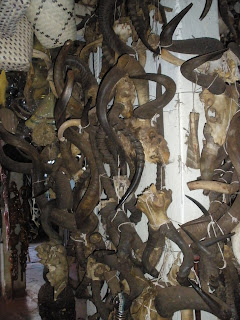
… and more to do with weird, dried animal skins and bones, and other rather creepy items within the traditional healer’s domain.


A vestige of the apartheid era – a sign that designated this shop as a “non-white shop.”


The Hector Pieterson Memorial, a tribute to the student uprising sparked by a mandate to use Afrikaans as the language of the classroom. The stones are meant to symbolize the students' solidarity.


Iconic photo of one of the youngest victims of the violence – Hector Pieterson – being carried by a fellow student.


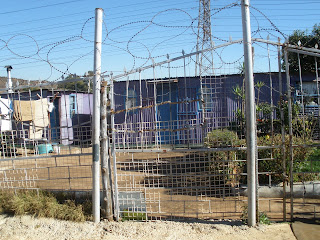
...a city of opulent mansions fortressed in by imposing walls and arresting coils of barbed wire as well as a city of lawless neighborhoods crippled by violent crime, unchecked corruption, and crushing poverty.


Nelson Mandela’s House, in the leafy, suburban neighborhood of Houghton

St. John’s Boys Academy, also in Houghton


Hillbrow, arguably the most dangerous section of Joburg which ironically sits adjacent (and in stark contrast) to Houghton


... a city of townships, like the Southwest Township more commonly referred to as “Soweto.” Soweto was a vibrant community of unique homes and a surprising lack of crime (achieved through a fierce version of community police). Low crime notwithstanding, Soweto was not without its areas of squalor.


The ubiquitous barbed wire


... a city of gold. Joburg was founded as a mining town, and supposedly there is still gold to mine for another 80 years or so….

Note the yellowish tint of the soil from the gold deposits

Monday, May 26, 2008

Miscellaneous May

May has come and gone and it was filled with no one special event but several miscellaneous ones…

Strumming my pain...
In an attempt to de-oxidize the rust caked onto my musical skills, I have started taking guitar lessons. My teacher, Aimé, has been extremely patient as I whine about my tender finger tips and inability to play the damn F chord. For all the frustrations though, it has been great fun to exercise the repressed musician in me and serenade Melanie and the guards with really abhorrent renditions of Amazing Grace and Edelweiss.


Party on, party people...
Perhaps it’s that time of year or perhaps it’s just the ephemeral schedules of the expat set in Kigali, but I feel like I’m continuously attending an unending procession of parties, often of the ‘welcome back’ or ‘going away’ variety. Some are more titillating than others – a wine and cheese party, for example, has more caché than your average fete since both wine and cheese are difficult to find a) for reasonable prices or b) in good quality. Friends who have recently been abroad sometimes return with such hard-to-find riches and magnanimously host parties to share the booty. Garron and I hosted a dinner party (a follow-up to the wildly successful Mexican Fiesta Fiesta dinner party of March) of our own as well. The highlight was a dessert of pure indulgent genius – vanilla ice cream topped with home-made peanut butter sauce and fried bananas. Comme d’habitude, hats off to the chef extraordinaire, Garron!

The hills are alive... with the sound of running...
Along with some other intrepid runner friends, I ran the Kigali half-marathon on May 11… Crossing the finish line of the 21-km course in Amahoro Stadium, I was flooded with the usual endorphin-high but felt the reward especially hard-earned this time. The hills combined with a shortage of water at most stations made for one tough, tough course… perhaps the most challenging one I’ve ever done.

Remarkably, I was snapped crossing the half-way mark looking relatively uncrumpled and pain-free. Usually these action shots from races are the most unflattering pictures possible, but I was so pleased by this one, I thought it blog-post-worthy. I can’t believe I was actually smiling when I still had 10 more kilometers to go.


Post-race, some friends threw a BBQ at their lovely home where we nursed our sore muscles and gorged ourselves on grilled kebabs, potato salad, cake and champagne!


And they called it, the Birth of the Biz...
For those of you who don’t already know, Garron and two of his bschool friends have started an MBA admissions consulting business… www.elitembaadmissions.com
Check out the website and get them clients. There’s a juicy little referral fee involved…

Wednesday, April 16, 2008

April

I see him there, the Torso Man, propped in a wheelchair in the grass along the sidewalk. The first time I saw him I thought my eyes were deceiving me, that somehow my mind had erased his lower half. I occasionally see him on my walks during lunch, and I avert my gaze because it somehow seems gratuitous to look at him. How did this happen to him?

I see those gardeners pruning grass and bushes using machetes. I have seen it for 7 months now, and it still shocks me. No lawn mowers or real gardening clippers. Just machetes. I wonder how people can stand to see them and not be reminded of their painful past. Would it have been worthwhile to ban these things?

I see the house and sometimes wonder whether it was standing that year, and if it was, I wonder about the marks on the kitchen floor. How did all those chips in the tile get there?

~~~~~~~~~~~~~~~~~~~~~

April 7th kicked off an official period of remembrance for Rwanda – a week without sports (hotel swimming pools were drained, gyms were closed, and soccer matches were banned) and merriment (bars and clubs were shuttered).

_______________________________
100 days

The genocide lasted about that long in 1994, starting April 6 and ending in mid-July. In that time, nearly a million people were slaughtered.
_______________________________

I have refrained from making commentary on the genocide in this space mostly because, as a muzungu and newcomer to this country, I don’t feel comfortable talking about something that I only first heard about from Anderson Cooper reporting on Channel One during high school homeroom period.

So let me restrict my thoughts to the following: on the whole, I have been surprised by how seldom – on the surface – the people bear the outward marks of genocide. Naively perhaps, I came prepared to be continually jolted by the human scars of an unspeakable inhumanity.

Instead, I have met Rwandans who are rather stoic and reticent about the divisions that caused the bloody rift in their nation… As a muzungu, I am not privy to the nuances in relationships among Rwandans themselves, and though I have the overwhelming sense that the country is moving forward, I hear little and big things that make me think that the wound is still quite raw.

The little things…

The email had the form-letter air of most company-wide notices:

“Earth Station informs all RWANDATEL Staff the death of one staff member, THEOPHILE GATARE, happened last night in a moto accident at Kanombe around 20:00.”

The news it brought sudden and sad.

Even though I had never met Mr. Gatare, I felt a palpable sense of loss as a junior member of the Rwandatel community.

But unbelievably, the story would become much worse. Far more scandalous, in fact.

Apparently his death was no accident.

The car that struck down Mr. Gatare was driven by the Executive Secretary of the Kigali City Council, Mr. Peter Uwimana.

http://www.newtimes.co.rw/index.php?issue=13460&article=4640

Allegedly, Mr. Uwimana may have intentionally targeted Mr. Gatare because Mr. Gatare testified against one of Mr. Uwimana’s close family relatives in a Gacaca court.

“Meanwhile some furious family members have alleged that there might have been intentions of killing Gatare in a purported road accident because he testified as a witness in a Gacaca court against a close relative to Uwimana.”

_______________________________
Gacaca (“gah-CHA-cha”)
(wikipedia.org)

The Gacaca Court is part of a system of community justice inspired by tradition and established in 2001 in Rwanda, in the wake of the 1994 Rwandan Genocide. After the Genocide, the new government struggled with developing just means for the humane detention and prosecution of the more than 100,000 people accused of genocide, war crimes, and related crimes against humanity. By 2000, approximately 120,000 alleged genocidaires were crammed into Rwanda’s prisons and communal jails.

From December 1996 to December 2006, the courts managed to try about 10,000 suspects: at that rate it would take another 110 years to prosecute all the prisoners. To speed things up, some prisoners were released: In two rounds in 2004 and 2005 about 50,000 prisoners were released. Just recently (January 2007) it has been decided to release another 8000 prisoners.

However, the courts needed a more expeditious means of delivering justice. In response, Rwanda implemented the Gacaca court system, which has evolved from traditional cultural communal law enforcement procedures. However, the system has come under criticism from a number of sources, including the Survivors Fund, which represents survivors of the genocide, due to the danger that it poses to survivors. There has been a number of reports about survivors being targeted for giving evidence at the courts.
_______________________________

So Mr. Gatare, after surviving the genocide and losing his wife and 4 children, perished tragically in a seemingly senseless act of revenge, leaving behind his new wife and 3 children.

Incomprehensible, really.

The big things…

Just last Thursday, during the week of remembrance, someone threw a grenade into the Genocide Memorial (an impressive museum and tribute) grounds, killing a police officer and wounding another…

http://www.newtimes.co.rw/index.php?issue=13498&article=5519

That same day, someone drove his car into a procession of students leaving a memorial service, killing one student and injuring a handful more. The report mentioned that the driver did not have a driver’s license, but the whispers among people suggest that the driver did it on purpose…

http://www.newtimes.co.rw/index.php?issue=13498&article=5521

Tuesday, April 8, 2008

RUN FOR THE BORDER

Uganda would not go quietly into that dark night.

No, it went kicking and screaming, like a fussy child who isn’t quite ready for bed.

Our departure from Uganda was a real comedy of errors, plagued by calamity after calamity, starting with a flat tire and ending with a mad dash for the Uganda-Rwanda border…

After the turbulent drive to Kampala, we found that the car was worse for wear: Saturday morning, we awoke to find the car had one very sad looking flat tire. Fortunately, providence intervened in the form of essential equipment (spare tire, jack, etc.) and mechanical-savvy individuals (Lillian). So on Sunday night, the eve of our departure, Lillian and Garron rolled up their sleeves and triumphantly changed out the flat tire.

Day of Departure, 9:00 AM

With the car loaded, we put on our game faces, ready to tackle the 10 or so hours of that awful drive. Knowing that it would take ~8.5h out of 10 to reach the Uganda-Rwanda border, and knowing that the border would close at 7:00 PM, we figured that we had a good 1.5h cushion to ensure we reached the crossing in time.

All ready to go, and… click.

The car wouldn’t start.

We regretfully realized that, after two days of idling in the parking lot, the car battery had died. (Most cars have such poor batteries they require you to drive them on a consistent basis to keep the juices flowing, so to speak.)

The staff at the guesthouse kindly called someone to assist us.

(Getting the car jumped… Note the sour expression on my face)

9:20AM

A bit behind schedule, we still figured we would be in good shape for the drive and the border…

Unfortunately, the spare tire would not cooperate with us… It tugged at the steering wheel and felt totally misaligned… Worried that either it or the car would not fare well on the trip, we pulled into a garage to have the pressure checked.

(Pot-holes-cum-ponds on a Kampala road)

As it turned out, the pressure was somewhere “close to exploding” (the mechanic’s words), so our only recourse was to repair the original tire and change out the spare.

(At the garage, fixing the original tire… Lillian being our advocate for all matters car.)
9:45 AM

A little more behind schedule, we felt confident now that, with a rejuvenated tire, we could make up some time on the road and still reach the crossing in time…

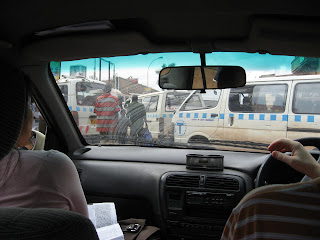
Sadly, my navigational skills failed me a bit on our exit from the city, and put us squarely in the middle of a bus depot.

(Crush of buses)

10:00 AM

Extracted from the traffic mess, we breathed a sigh of relief, picked up some speed and finally, felt on our way…

10:30 AM

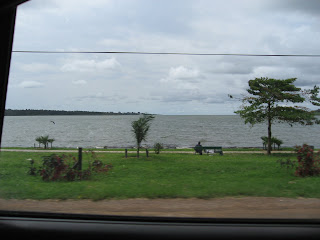
Sarah: “Oh look! That must be Lake Victoria! How pretty!”

(Lake Victoria)

Lillian: “I don’t remember seeing it on the way here…”

Me: (sinking feeling) “OH CRAP.”

I frantically flipped open the map and realized that we had been traveling 30 minutes in the wrong direction.

Once again, my navigational skills failed me and if it were physically possible for me to give myself a solid kick in the pants, I would have.

11:30 AM

Having back-tracked back to Kampala and re-directed ourselves on the correct path, we picked up the pace, knowing that our border-crossing window had now become much narrower…

We stopped to get gas in a dusty little outpost called Lukaya.

After the debacle with the battery, we all chanted to ourselves that we must NOT turn off the engine, we must NOT turn off the engine.

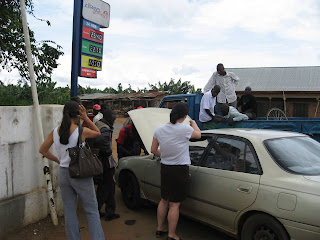
So, we filled the tank with the engine running (tsk tsk, I know), stretched our legs for a bit, hopped back in and… click.

Garron hit the ignition again and succeeded in shutting off the engine. And as luck would have it, the car wouldn’t start again.

The garage brought help to jump the car and after multiple tries, we found that this time, the battery was not the culprit. A mechanic discovered that the starter needed to be repaired. So we begged him to please do it, whatever it takes.


(Getting the car fixed in Lukaya… You can’t see it, but I have another sour expression on my face)

12:00 PM

One-hundred dollars poorer, we liberally thanked the mechanic, hastily jumped in the car and pressed on the gas.

Now we were in real danger of not making the border in time, and there was no time to waste.

Garron calculated that we needed to maintain an average speed of 100 km/h in order to make it there in time, which, given the state of the road and the many, many challenges (reckless trucks and buses, livestock… see previous post) along the way, was asking a lot…

Afternoon-ish

Lillian: “Do you guys hear that? It sounds like something rattling.”

We pulled over, left the car running, and inspected the car. There was nothing visibly amiss, but there was some strange leakage. “Oh well, no time to stop and worry – we have a border crossing to make!”

We hopped back in and sped off again.

_______________________________

Zero Degrees

Kampala, Latitude = +0.19 degrees
Kigali, Latitude = -1.195 degrees

With no time to play tourist, we saw the big white round sign whiz by and thought,
Oh how cool. We’ve just crossed over the Equator.
_______________________________

Late afternoon-ish

A large rock (or something) flew up into the windshield and gave it a lovely snowflake-shaped crack. Then like a shooting star, it crept laterally across windshield.

Great.

6:55 PM

At the expense of fried nerves and cold sweats, we made up significant time and reached the Ugandan border with only 5 minutes left.

With the crossing in sight, we armed ourselves with passports and pens, ready to leap out of the car and attack the Ugandan immigration desk.

At this late hour, immigration was blissfully line-free and we filled out our departure forms and exchanged niceties with the immigration officers in record time. I even managed to make friends with the gentleman who assisted me with the car’s customs declaration.

6:58 PM

We piled back in the car, and… click.

Garron: “Oh my gosh.”

Sarah: “Garron, STOP JOKING.”

Garron: “I’m not kidding. The car won’t start.”

Like 4 chickens that had recently lost their heads, we leapt out of the car and started flailing about.

Me: “Put it in neutral and we’ll push the car over the border!!!”

Luckily, a Ugandan offered to look under our hood, and quickly spotted a cable that had become disconnected from a diode of the car battery. He reconnected it and voila! The car started.

We burst into rapturous applause and probably startled him with our disproportionate response to his simple solution. After slapping the last of our Ugandan shillings into his hand, we sped the 400m or so across the border and re-entered Rwanda.

7:00 PM

Me: “Where is my passport? Omigosh, I just had it. WHERE IS MY PASSPORT?!?”

The rest: “What?!?”

Like 4 chickens that had recently lost their heads, we leapt out of the car and started flailing about.

Frenetically, we started emptying all the compartments of the car, rooting around like children in the bottom of their toy chests. Garron even re-popped the hood.

Helpful Rwandan, inspecting under the hood: “What’s the problem?”

Garron: “She’s lost her passport.”

Helpful Rwandan, puzzled: “And you’re looking in the engine?”

Garron: “I don’t know, she lost it over there, and we looked under the hood…”

Meanwhile, I was breathlessly running circuits of the 400m dash between the car and the border crossing, furiously gesticalating over the gate to ask my new-found friend on the other side to check if he had seen a passport lying around.

I imagined what the locals must be thinking, as they watched the scene unfold:

A car of muzungus blazes up to the gate in a cloud of dust. They jump out of their car and run into the office. Five minutes later, they reemerge, jump back in their car, and after a few seconds, jump out again and start circling the car and shaking their heads. The Blond Girl looks like she will cry. A Very Wise Ugandan diagnoses the car problem and they jump back in the car and drive to the Rwandan side. On the other side, they jump out of their car again and start throwing away everything inside their car. One of the Chinese Girls starts some sport of running back and forth from the car and the gate. Her hair is a mess. Strange muzungus.

7:05PM

Miraculously, I found my passport, slyly tucked flush against the inside pocket of the passenger door, where I had put it in the first place. Je suis une IDIOTE.

Frazzled, we pounded against the window of the Rwandan immigration desk, pleading with them to process our paperwork: “Yes, we know it’s late, but we just came through Ugandan immigration, and if you could just please, please help us...”

Perhaps they saw our weary mugs, streaked with sweat and wild-eyed with desperation, and felt sorry for us, because even though we were 5 minutes late, they went ahead and stamped our passports.

So Rwanda welcomed us home. And the return never felt so sweet.

Tuesday, April 1, 2008

Uganda: Cheating Death

The trucks were parked totally helter-skelter across the road. The damp dirt road lacked markings for lanes or any delineation between the side of the road and the road itself. Some trucks faced north, some pointed south with their cabins angled to the east, no order, rhyme or reason, they idled or had drivers asleep behind the wheel giving the appearance that Sarah, Lillian (visiting friends from the US), Garron, and I would NEVER weave our way through this border crossing.

With the help of an entrepreneurial young man who herded the lumbering vehicles out of our way, we squeezed through a canyon of trucks with nary a paper’s width of space to spare on either side.


Catching our breath and relieved that we squeezed through relatively unscathed, we settled in for the long drive to Kampala, Uganda, my first foray into Rwanda’s neighbor to the northeast and one of its East African Community brethren.

Suddenly we noticed a truck barreling down our lane – the right lane – with no apparent intention to slow down. He flashed his lights and in the nick of time careened to the left with his trailer dangerously fishtailing behind him. It then dawned on us that – now that we were in Uganda, old British colony that it is – we should be driving in the left lane… So this little game of chicken was our sobering introduction to a long-weekend trip to Uganda... and the first in a series of moments that can only be described as cheating death.

The drive was long.

In the beginning, I enthusiastically soaked in the scenery of a new countryside, one that – just past the Rwenzori Mountain Range – changed to a tree-lined expanse of green tempered by hilltops of rocky soil, a marked difference from the plush dense vegetation of Rwanda’s hills. I also had the sense that Uganda was slightly more developed, based on my very scientific observation that there were more houses and churches along the way that were made of sturdier materials like tin and concrete rather than mud and clay.

_______________________________

Rwanda GDP (nominal) per capita = 286
Rwanda GDP (PPP) per capita = 1000

Uganda GDP (nominal) per capita = 368
Uganda GDP (PPP) per capita = 1100
_______________________________


Nine hours or so later, I was no longer enthralled by the views. The ride had turned into my personal version of hell.

Near-death Experience #1

Both sides of the road were so eroded from rains and wear-and-tear that what should have been a 2-lane thorough-fare was really a 1.8-lane fight-for-the-road. Trucks or towering buses would come recklessly flying through bends, elbowing us off the road and forcing us to rattle along the ragged edges.

Even when we could avoid the edges of the road, we still had massive potholes with which to contend, some of which were so deep, I could swear they led to all the way to Hawaii. For a ride this long and roads this poor, hitting potholes became totally unavoidable. My forehead throbbed from constantly wincing, my hand ached from white-knuckling the door handle and my tailbone felt more and more bruised each time the chassis violently banged into a pothole or scraped against some monster speed hump. One particularly nasty pothole caught us by surprise and after hitting it especially hard, the dashboard lit up and the windshield wipers and turn signals came on simultaneously.

Between the reckless buses and potholes, the schools of villagers on bicycles that would swim onto the road, the tense gamble of passing cars on such a narrow road, and the random piece of livestock (mostly steer with alarmingly thick and pointy horns) that wanders into the road, I saw my life flash before my eyes on more than one occasion.

I sometimes like to live life on the edge, but not this kind of edge. The next time we go to Kampala, I will insist that we fly.

When we finally reached Kampala, we found a lively, bustling capital city (population 1.2 million) teeming with cars, pollution, chickens, and enticing Indian restaurants. We spent Saturday touring the city, stopping in a pan-African crafts village and visiting Kabaka’s (= king, in Luganda) Palace. We stayed in an adorable guest house with just 6 rooms and met up with two other friends – Hugh and Clara – there.


(mosque on the hill)


(Mambo Point Guesthouse)


_______________________________
Uganda Fast Facts


Population: 30 million
Capital City: Kampala
Lingua franca: Luganda
Official languages: English and Swahili

Primary Exports: Coffee, tea, sugar, cotton
Religion: 84% Christian, 12% Muslim
Independence: 1962
Most notorious despot: Idi Amin
_______________________________


Near-death Experiences #2, 3, 4…

As nice as Kampala was, we really went to Uganda for one reason: to go white-water rafting in Jinja.

Jinja, a town about an hour east of Kampala, has played host to the adventurous in recent years with a number of tour companies based there, running rafting trips on the rapids of the Nile River.

After getting outfitted in life jackets and helmets, we piled into pickup trucks and jostled down some dirt road to meet the illustrious “White Nile.”


The six of us commandeered an inflatable red raft with Peter as our guide and coach, a young Ugandan with a serious exuberance quotient and healthy sense of humor.

Peter: “I used to be a white boy from Canada, but I’ve spent too much time in the sun in Africa.”
Peter: “Don’t worry about the crocodiles. They’re vegetarian. Except for the white meat.”

Act I: The Playground

Like children learning to ride bicycles, we spent the first few kilometers of our river ride getting a feel for the raft and learning the basics, i.e. how to row in sync, learning what to do when the raft flips, learning not to freak out if you’re trapped under the raft, learning how to ride the rescue kayaks after you’ve been dumped into the water, etc.

_______________________________
Commands

“Go forward!” = row forward
“Go forward hard!” = row forward, hard
“Hold on” = stop rowing, grip the rope with your outside hand, and lean toward the center
“Get down!” = stop rowing, crouch down, hold onto the rope, and try not to sh*t yourself as you go over a big rapid
_______________________________


After doing ‘test flips’ of the rafts, the guides let all the rafters swim and float for several kilometers, carried along by the current. What a fun yet odd sensation to exert no effort but to watch the banks of the river pass by at a swift clip, feeling bathed by the warm and surprisingly clean waters and holding conversations with your fellow rafters as if sitting in a coffee shop, remarking on the lovely green vegetation and dearth of villagers on the river’s banks. It was child’s play: a smattering of pink and blue helmets drifting down the river, some horsing around and tossing pieces of vine at one another, some chatting away, some just serenely watching the scenery pass, perhaps taking mental notes of the scene.

Occasionally I would remind myself that it was Easter Sunday, and I was floating in the Nile River. Surreal.

Act II: “This is not fun”

After trying a few easy Class 1 and 2 rapids, we suddenly felt as if someone had savagely ripped off the training wheels from our bikes and threw us to the mercy of the big scary open road: we took on some serious Class 3, 4 and 5 rapids and quickly realized that this was no longer child’s play.

Class 3 rapid “50-50” gave us our first flipping and while most of us tumbled through the waves relatively trauma-free, poor Sarah was stuck under the upturned boat for a while and eventually emerged looking like she had seen a ghost.

Most of us – with perhaps the exception of Sarah – were still feeling pretty hardy and eager to continue challenging the rapids… that is until we encountered the Class 5 rapid, “Silverback.” This aptly named beast of a rapid flipped us in the very beginning, spilling all of us into the violent churn and leaving us to traverse the whole rapid sans boat. I can only recall being plunged into the water, being thrust through a veritable wash cycle of waves and feeling a bit panicked that I would drown if I couldn’t come up for air soon. I burst through the surface with a gasp and emerged to witness the carnage of upturned red rafts, strewn oars, and rescue kayaks plucking shell-shocked rafters from the surf. Only a minority of the boats fought the Silverback and won; the rest were ruthlessly pummeled like us.

Given the conditions, naturally we couldn’t bring cameras, but a fellow rafter in the blogosphere kindly agreed to let me link his post to my blog. Check this out and look out for the red rafts. That’s what we did.
(Thank you very much, Max!)

http://xackers.net/pages/DefaultFrame.aspx?ID=3040&fiID=156281

Act III: Cool-down

Fortunately, we had a short respite after that, a chance to feel truly humbled by Mother Nature, to kick ourselves for not having written our last will and testaments yet, and to munch on fresh pineapple and biscuits.

The sun and heat of Kampala did not revisit us on the river; instead, the sky stayed overcast and it rained all. day. long. I felt like a sorry wet dog, thoroughly chilled to my core. Everyone’s lips had a bluish tinge and the girls’ jaws visibly chattered. The post-lunch stretch of rapidless river meant we had some long kilometers to row, which helped us to fixate on something other than being so achingly cold. At times we were a solemn crew, with only the sounds of the lapping water and raindrops in our ears. We were thankful for the breaks from the rowing, when we could jump in the water and be momentarily warmed, only to have the warmth quickly washed away by the unrelenting rain. It danced on the river in undulating waves, making the surface twinkle like a sheet of silver sequins in the overbearing grayness.

_______________________________
Whitewater Rapids 101: Classification.
www.about.com

Class I: (Easy) Moving water with small disturbances on the surface and a few small waves. There is little to no danger to swimmers.

Class II: (Novice/Beginner) Faster moving water with easily avoided rocks, holes, and waves. Danger to swimmers is still slight but care must be taken.

Class III: (Intermediate) Fast moving water containing various rocks, holes, currents, and waves that require skillful maneuvering to avoid. Swimmers could be at risk and may require help.

Class IV: (Advanced) Strong rapids, large waves, big holes, unpredictable currents, and dangerous obstructions requiring multiple maneuvers to get through or around. Swimmers are at risk and will require help to be rescued.

Class V: (Expert) All of the characteristics of Class IV with the added danger of being longer and containing more continuous features that may not be avoided. There is serious risk to swimmers and others may be of no help.

Class VI: (Unrunnable) Only a team of experts who carefully plan every aspect of this expedition would have hope of surviving these rivers and rapids.

Rumor has it that Class VI is basically un-survivable!

_______________________________


Act IV: Itanda, or “The Bad Place”

After seeing my life flash before my eyes – yet again and several more times – I developed an intense anxiety about tackling the next set of rapids, which totally displaced the blind enthusiasm I had at the beginning of our run.

The next Class 4 flipped us – seemingly with very little effort – but fortunately, the gods of whitewater rafting spared us on the next set of rapids and the entire boat made a joyous noise, utterly euphoric for having navigated the waters and winning, this time.

We couldn’t ride our wave of ebullience for very long, for lurking not far from our victory was the infamous Itanda, or “The Bad Place.”

Sarah, Lillian, and I decided that we had filled our adventure quota for the day (or really, for at least a year), and opted to watch the more daring rafters tackle Itanda from the safety of the banks.

Staring at the long crush of white rapids, I could think only two things: 1) the soundtrack to this would be Beethoven’s Symphony #9 and 2) anyone who runs this rapid must have taken leave of their good senses. A long time ago. It was frighteningly monstrous.

Garron, Hugh, and Clara, along with a surprising number of less pussy-footed rafters, ran the last half of the rapids (the whole set of rapids constitutes a Class 6 which – if you read above – would be a death wish) which included the giant wave known as “The Bad Place.”

Sarah, Lillian, and I felt nervous watching them hit the wave, but they flipped (it’s apparently impossible not to) and all three popped up in no time flat. Relieved, I turned to see Peter jumping up and down on their up-turned boat, squealing, hooting and hollering something just short of certifiably crazy. A daredevil at heart, he must be someone who’s spent a little too much time getting regular injections of adrenaline.

Epilogue

We climbed the river’s banks and sloshed through mud and grass in our bare feet. I think I saw the world’s biggest, blackest caterpillar and prayed that I wouldn’t contract some freakish Nile River disease from some other strange bug in the water or bush. It felt like Romancing the Stone without the romance and the stone.

As we waited for our rides in the still unrelenting rain, still cold and wet and now painted in mud, I felt strangely happy that our Ugandan adventure was as riddled with risk as it was, and we pulled through scot-free and all the more emboldened for it.